Anatomy · Physiology · Research
Understanding jaw and TMJ pain
Anatomical references, proposed mechanisms and analysis of scientific data.
On this page
Scientific dossier · Separate reading of practical advice
Functional and biomechanical anatomy
The two temporo-mandibular joints combine mandible and temporal bone. They combine rotation and translation with a fibrocartilaginous disc. Masticator muscles and sensorimotor control allow to talk and chew. Temporo-mandibular disorders cover different muscle and joint diagnoses.
Physiology and mechanisms of symptoms
Joint noise can occur without pain or limitation. Teeth tightening, stress context and habits can contribute to impact, but are not a single explanation. The position of the teeth or an orthodontic treatment should not be automatically identified as a cause of the disorder.
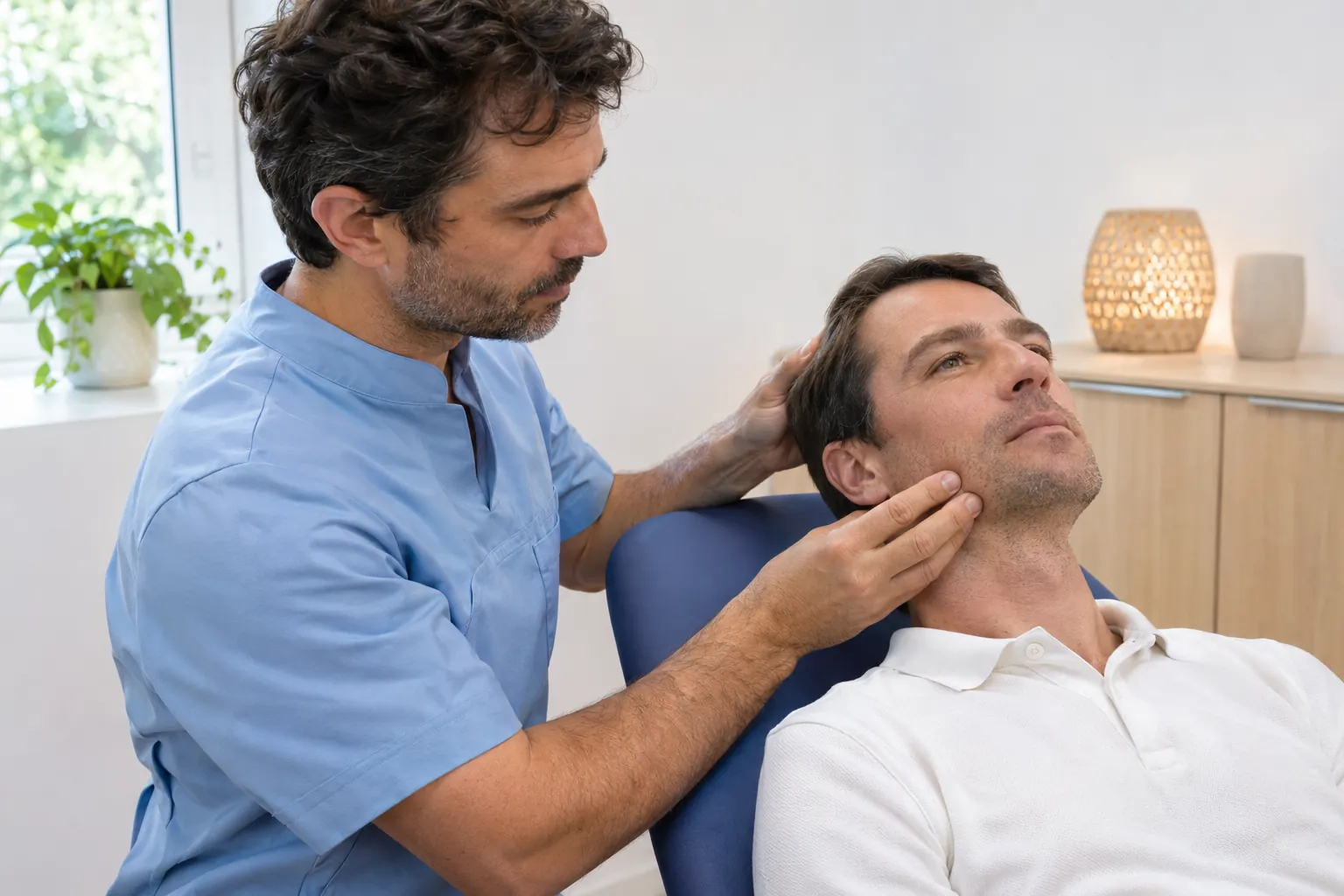
Clinical reasoning and guidance
The physician or dentist may seek a dental cause, blockage, trauma or joint disease. The movement, the ability to feed and the associated symptoms guide the examination. A pain in the temple with visual impairment or an impossibility of drinking must not be attributed without balance to jaw tension.

Scientific data and recommendations
Recommendation BMJ 2023 deals with chronic temporo-mandibular pain, which has been present for at least three months. It supports several conservative approaches, including education and supervised exercises, and some manual interventions. It does not concern all acute pains and does not demonstrate the superiority of an osteopathic method.

What the results do not support
Unreversable actions that alter occlusion should not be trivialized. The response to a relaxation technique does not establish a correction of the disc. Treatments are discussed according to the diagnosis, preferences and expected benefits; they do not choose on isolated noise.
Functional monitoring and coordination of care
The follow-up is interested in chewing, yawning, talking and sleeping, with a comfortable amplitude rather than a maximum repeated opening. The habits and exercises chosen must be simple, tolerable and suitable for diagnosis. A limitation that progresses or a persistent blockage justifies contacting the referring professional again.
Scope of this file
- Population and situation
- Handkerchief and ATM: discomfort for chewing or opening. The results must be interpreted for this specific situation.
- Choice of care
- Recommendation BMJ 2023 deals with chronic temporo-mandibular pain, which has been present for at least three months.
- Security priority
- Difficulty drinking or feeding, persistent blockage, trauma, swelling or pain with fever require advice. A pain of the temple with visual impairment requires an urgent assessment.
Coupled movement and symptom diversity
The mandibular opening combines rotation and translation with a coordination of the masticator muscles. Joint disc, bone surfaces and muscle tissue may be involved in different tables. Painless joint noise is not a disease to be corrected at all costs. The reproduction of pain, comfortable amplitude and history of blockages provide information, but dental causes or other facial pain must remain considered.
A recommendation for a defined population
The BMJ recommendation of 2023 concerns pain associated with chronic temporo-mandibular disorders, with symptoms for at least three months. It supports several conservative approaches according to their balance between benefits and constraints. Its field does not allow to generalize to acute traumas, infections or blockages. The manual interventions proposed in this framework do not prove a definitive correction of the occlusion; masticatory function, pain and resounding remain useful criteria.
Bibliography and original documents
Editorial and documentary review: November 5, 2026. The references describe their scope; they are not valid for all osteopathic practices.