Anatomy · Physiology · Research
Understanding wrist and hand pain
Anatomical references, proposed mechanisms and analysis of scientific data.
On this page
Scientific dossier · Separate reading of practical advice
Functional and biomechanical anatomy
The wrist combines the extremities of the radius and l的ulna, eight bones of the carp, ligaments and many tendons. Median, ulnal and radial nerves provide different sensory and motor functions. The symptoms of the hand must be described with their territory and context, rather than grouped under a single blocking diagnosis.
Physiology and mechanisms of symptoms
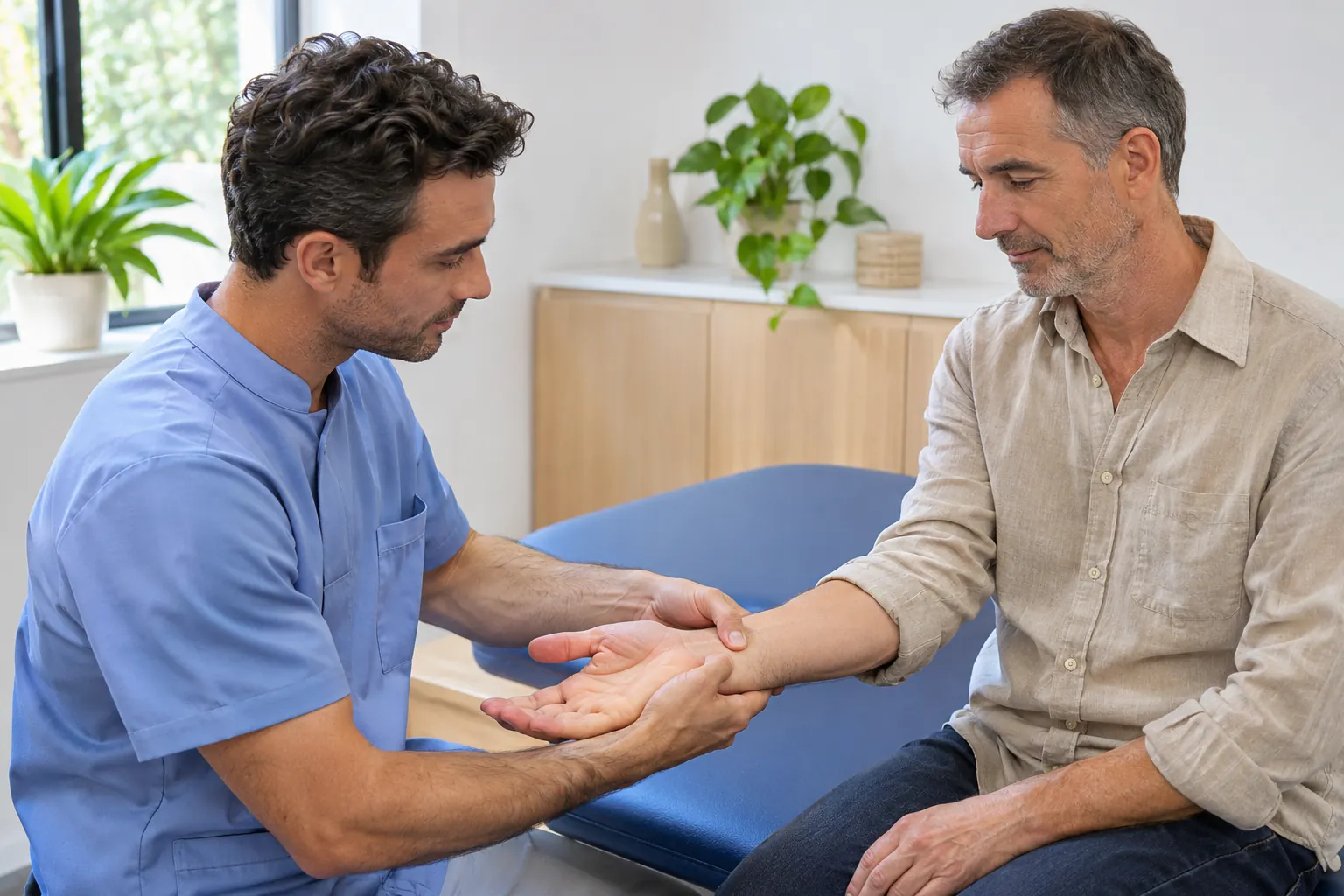
Tensons may become sensitive in certain grips or loads. Nervous compression can produce tingling, night discomfort and weakness. The location given by the patient is not always perfectly limited to a theoretical territory: clinical examination and sometimes complementary examinations make it possible to clarify the situation.
Clinical reasoning and guidance
After a fall, persistent pain may require a fracture search even without obvious deformation. A loss of sensitivity, a cold hand or a new weakness require rapid assessment. For progressive symptoms, the doctor is looking for nerve, tendinous or joint damage and associated factors.

Scientific data and recommendations
Recommendation AAOS 2024 deals with carpal canal syndrome in adults. It is a reference for the diagnosis and treatment of this specific condition; it does not allow any tingling of the hand to be attributed to a median compression or promise that an osteopathic mobilization will suffice to lift it.

What the results do not support
A decrease in numbness in a position does not show the disappearance of nerve damage. Treatment depends on cause and severity. Repeated actions to crack the wrist or stretch the nerves strongly do not replace a balance and may increase irritation.
Functional monitoring and coordination of care
Functional markers include writing, buttoning, wearing the child or maintaining a grip. Strength and sensitivity should be monitored when the balance indicates. Post and custom adaptations are chosen according to actual activities, in coordination with the doctor, physiotherapist or occupational medicine.
Scope of this file
- Population and situation
- Handle and hand: pain in fine gestures. The results must be interpreted for this specific situation.
- Choice of care
- Recommendation AAOS 2024 deals with carpal canal syndrome in adults.
- Security priority
- After a fall, persistent wrist pain should be evaluated even without significant deformation. Cold hand, significant loss of sensitivity or new weakness require quick advice.
Nervous distribution and differential diagnosis
The median nerve passes through the carpal channel, while other territories of the hand depend on ulnal and radial nerves. The distribution of tingling, their schedule and motor function can help the reasoning, without constituting a perfect diagnostic map. Symptoms may also come from a more proximal level or from a general condition. The medical examination and, depending on the context, the additional examinations allow for a clarification of the diagnosis.
A variation in symptoms does not prove decompression
The AAOS recommendation on the carpal channel concerns an identified condition and its management options. It does not lead to the conclusion that manual mobilisation releases the nerve for a long time. A study should include diagnosis, severity, nocturnal symptoms and function, as well as follow-up. A progressive weakness or persistent sensory impairment requires a re-evaluation of the situation rather than a multiplication of comfort interventions.
Bibliography and original documents
Editorial and documentary review: November 5, 2026. The references describe their scope; they are not valid for all osteopathic practices.