Anatomy · Physiology · Research
Understanding ankle and foot pain
Anatomical references, proposed mechanisms and analysis of scientific data.
On this page
Scientific dossier · Separate reading of practical advice
Functional and biomechanical anatomy
The ankle combines the tibia, fibula and slope; the joints of the foot complete the adaptation to the ground. Ligaments limit some translation and rotation, while muscles and tendons provide active control. The balance also depends on sensory information and its integration.
Physiology and mechanisms of symptoms
Torsion may stretch or break a ligament, but pain and swelling alone do not grade the lesion. After sprain, apprehension, lack of strength or perceived instability may persist. Recovery therefore involves more than the disappearance of oedema.
Clinical reasoning and guidance
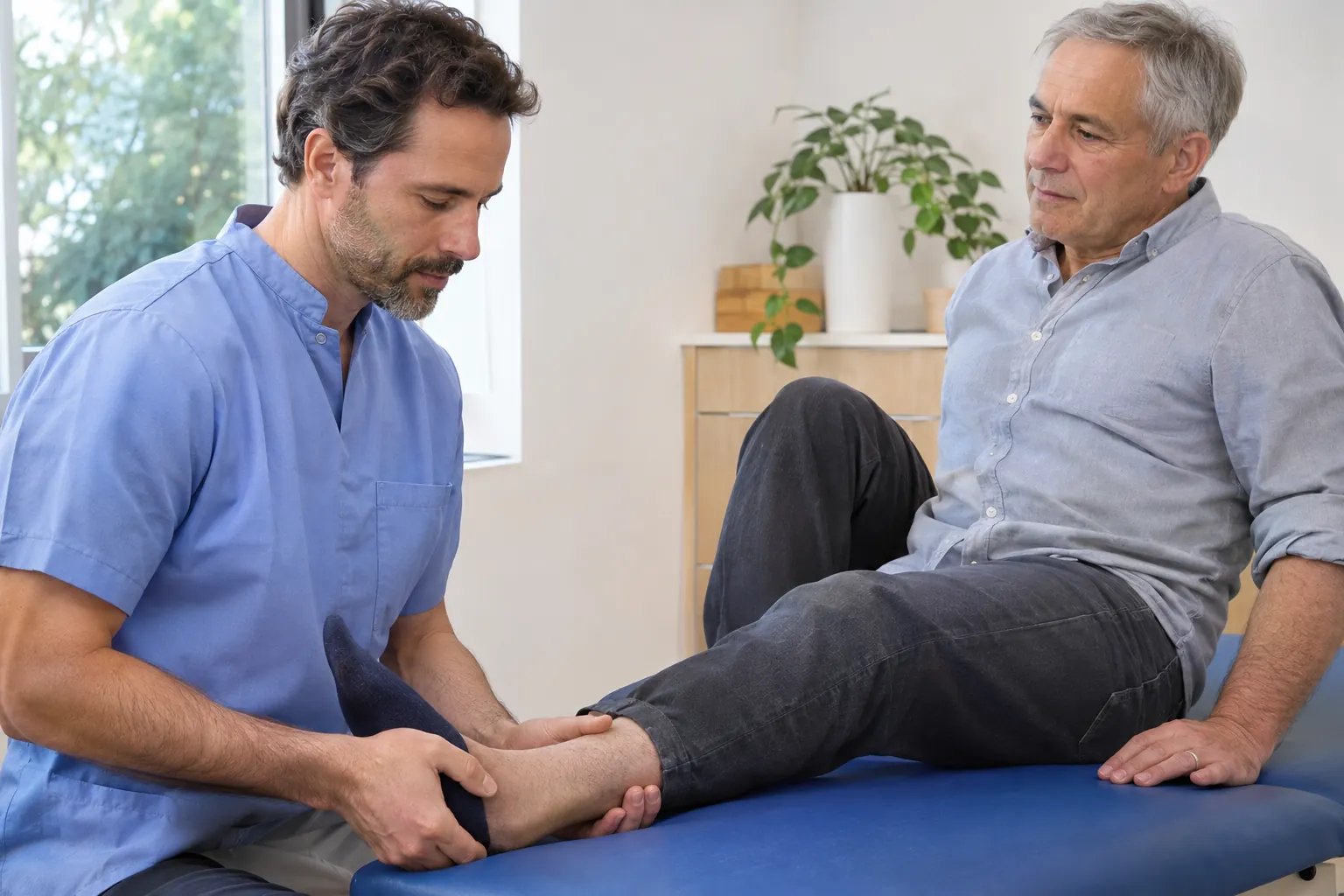
The balance sheet looks for a fracture or other injury requiring specific management. The ability to support, the mechanism of trauma and painful areas guide orientation and possible imaging. Cold foot, deformation or wound with infectious risk are not part of a first-intention mobilisation.

Scientific data and recommendations
Recommendation Jospt 2021 distinguishes first lateral sprain and chronic ankle instability. It provides a framework for evaluation and functional rehabilitation. A positive response to an isolated manual gesture does not demonstrate that the ankle is ready to resume steering changes or jumps.

What the results do not support
Plantar, tendinous, and joint pains do not all share the same path as sentorosis. The choice of shoes or supports is not enough to explain each symptom. A promise of a single foot correction or of certain prevention of recidivism would be unjustified.
Functional monitoring and coordination of care
Walking, uphill climb, balance and sports constraints are assessed according to stage and professional performance. The recovery is gradually being built up with criteria adapted to the activity. Repetition of episodes of giving way or pain that does not decrease deserves further evaluation.
Scope of this file
- Population and situation
- Cheville and foot: walk with more comfort. The results must be interpreted for this specific situation.
- Choice of care
- Recommendation Jospt 2021 distinguishes first lateral sprain and chronic ankle instability.
- Security priority
- Impossibility of support, deformation, severe wound, cold foot or pain with fever requires medical advice. In a diabetic person, a foot wound requires rapid attention.
Passive stability, control and exposure
Ligaments help to limit certain movements, while muscles, sensitivity and motor control contribute to stability in real-life situations. After a sprain, the disappearance of pain does not mean that all these abilities have returned. The foot also ensures the adaptation of support and the transmission of forces. The nature of the trauma, the possible support and the criteria for clinical evaluation guide the need for an initial medical check-up.
Acute sprain and persistent instability
The JOSPT recommendations distinguish between recent trauma and chronic instability. The place of a manual technique depends on the stage and other interventions, including exercises. A transient sensation of increased mobility does not prove a restoration of sports stability. To judge a program, it is necessary to monitor support capabilities, functional balance and episodes of giving way or new injury, taking into account exposure to activities.
Bibliography and original documents
Editorial and documentary review: November 5, 2026. The references describe their scope; they are not valid for all osteopathic practices.