These benchmarks are general. They complete an exchange with the professionals who follow you and do not replace a diagnosis or an individualized program.
Benchmark 01
From what you already eat
Before changing your diet, look at an ordinary day: where do meals become difficult to organize? An improvised lunch, too late dinner or a lack of shopping are different problems. Choose a single concrete difficulty. If lunch often ends with a snack, preparing a transportable meal can be more useful than looking for an exceptional food.
Note three meals that you enjoy, that keep in your budget and that you know how to prepare. They're your starting point. Nutritional quality is built on the repetition of sufficiently varied choices; a festive meal or dessert does not require compensation the next day.
Benchmark 02
Compose a meal that holds in real life
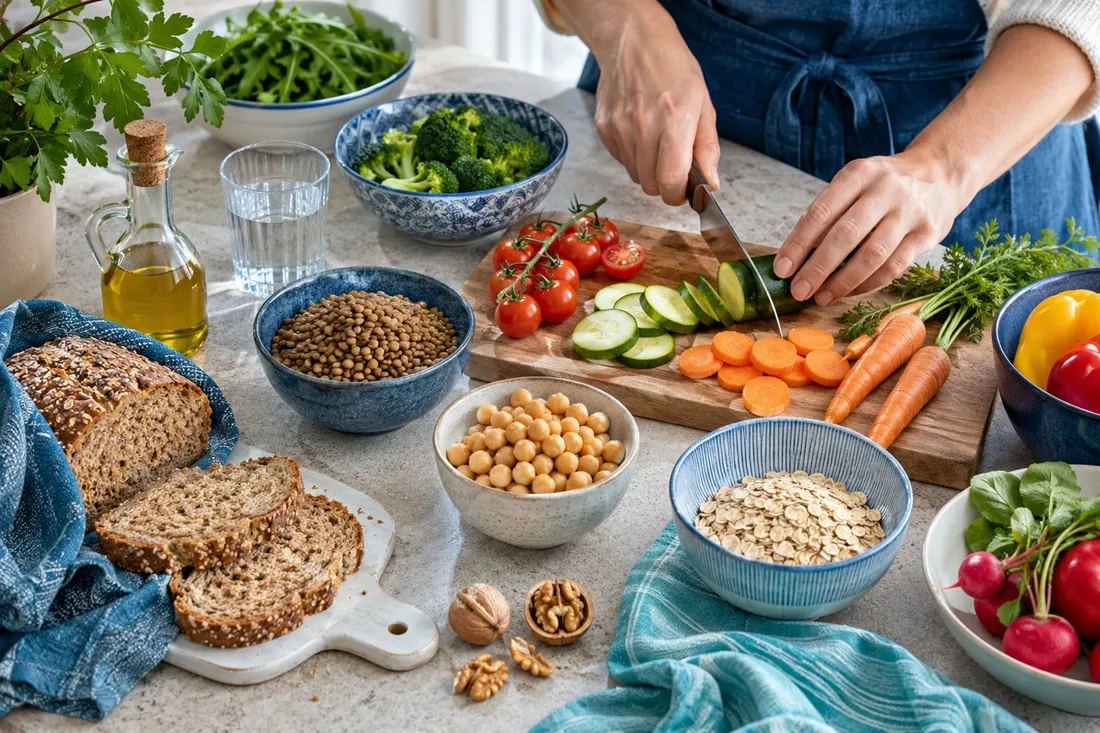
A practical benchmark is to combine vegetables or fruit, a source of starch and a source of protein, with a fat material suitable for preparation. Quantities depend in particular on appetite, activity and individual needs. This framework is an organizational aid, not a formula to be weighed systematically.
Example: rice, chickpeas and roasted vegetables; bread, eggs and crudities; potatoes, fish and frozen vegetables. Remnants can become a compound salad or sandwich garnish. Think of what is missing rather than banning everything: adding a vegetable to a familiar meal is sometimes the first simple change.
Bench 03
Do useful shopping, without looking for perfect products
A basic reserve can bring together natural frozen vegetables, canned legumes, bread or cereals, eggs and some foods you like. Fresh, frozen and canned products may coexist. Compare the labels of similar products when it actually helps your choice; there is no need to turn every purchase into an exam.
Before leaving, choose two preparations and check the closets. A list organized around concrete meals avoids coming back with ingredients without knowing how to use them. Also plan a backup solution: an omelette and bread, for example, can do service on a busy evening.

Benchmark 04
Adapt to active days
A meal that is suitable for a day of office does not necessarily resemble a walk or workout. If you are often hungry long before dinner, ask yourself if the lunch was nutritious enough and if a practical snack would be appropriate. A snack can be an organized choice, rather than a failure.
Drinking regularly is useful, but the needs are not identical for all. Heat, effort, medication or disease can change them. If a professional has prescribed a water restriction, his indications take precedence. Water is a usual simple drink; so-called detox drinks do not correct an inadequate diet.
Bench 05
Distinguish general balance and personalized monitoring
Recommendations for the population do not replace accompaniment for diabetes, digestive disease, allergy, pregnancy or undernutrition. Persistent fatigue is not automatically treated with a supplement. A suspicion of deficiency asks to clarify his cause with a professional.
Feeding should not become a permanent source of concern. If the fear of certain foods spreads or if the rules take the place, talk about it. A dietitian can help balance needs, pleasure and constraints without increasing exclusions. The tips on this page are not a weight loss program.
A first step
Your first change this week
Example of organization to adapt to your situation, without performance objective.
- Find a regularly difficult meal to organize.
- Choose a simple version with food available.
- Prepare two extra portions when it makes your life easier.
- After a few days, look at the feasibility and your satisfaction.
Traps to avoid
- Compensate for a hearty meal by skipping the following meals.
- Buy expensive products to follow a detox promise.
- Remove several food families without medical reasons.
When can I ask for an opinion?
Involuntary weight loss, difficulty swallowing, persistent fatigue or significant dietary restriction warrant consultation. A known allergy or disease requiring a diet requires individualized advice.

Your questions
Do you have to cook everything yourself?
No. Assemble what is compatible with your time: simple, canned, frozen and ready-made products can complement each other.
Does a meal always have to be perfectly balanced?
No. Look at the variety and organization over several days rather than each isolated plate.
Can I adjust these advices to my budget?
Yes. Build first around your accessible food and usual recipes, without looking for specialized products.
The documentary selection
See, read, deepen
French recommendations to compose his eating habits.
www.mangerbouger.frRecommendation · FrenchWHO — Healthy eatingInternational references to understand general principles.
www.who.intGuide / resource · EnglishNHS — Eatwell GuideVisual presentation of food groups.
www.nhs.ukGuide / resource · EnglishFood Standards Scotland — use guideExamples for moving from benchmarks to daily choices.
www.foodstandards.gov.scot