Anatomy · Physiology · Research
Understanding knee pain
Anatomical references, proposed mechanisms and analysis of scientific data.
On this page
Scientific dossier · Separate reading of practical advice
Functional and biomechanical anatomy
The knee includes the femoro-tibial and femoro-patellar compartments. Menisques distribute stresses and ligaments contribute to stability, while muscles produce and control movement. The load changes according to bending, speed and task: going down a staircase does not require the knee as a step on flat terrain.
Physiology and mechanisms of symptoms
Pain can combine joint, tendinal and load tolerance factors. Painless noises alone do not provide information about a lesion. A visible meniscal or cartilaginous anomaly may not be the main cause of discomfort; its meaning depends on the context.
Clinical reasoning and guidance
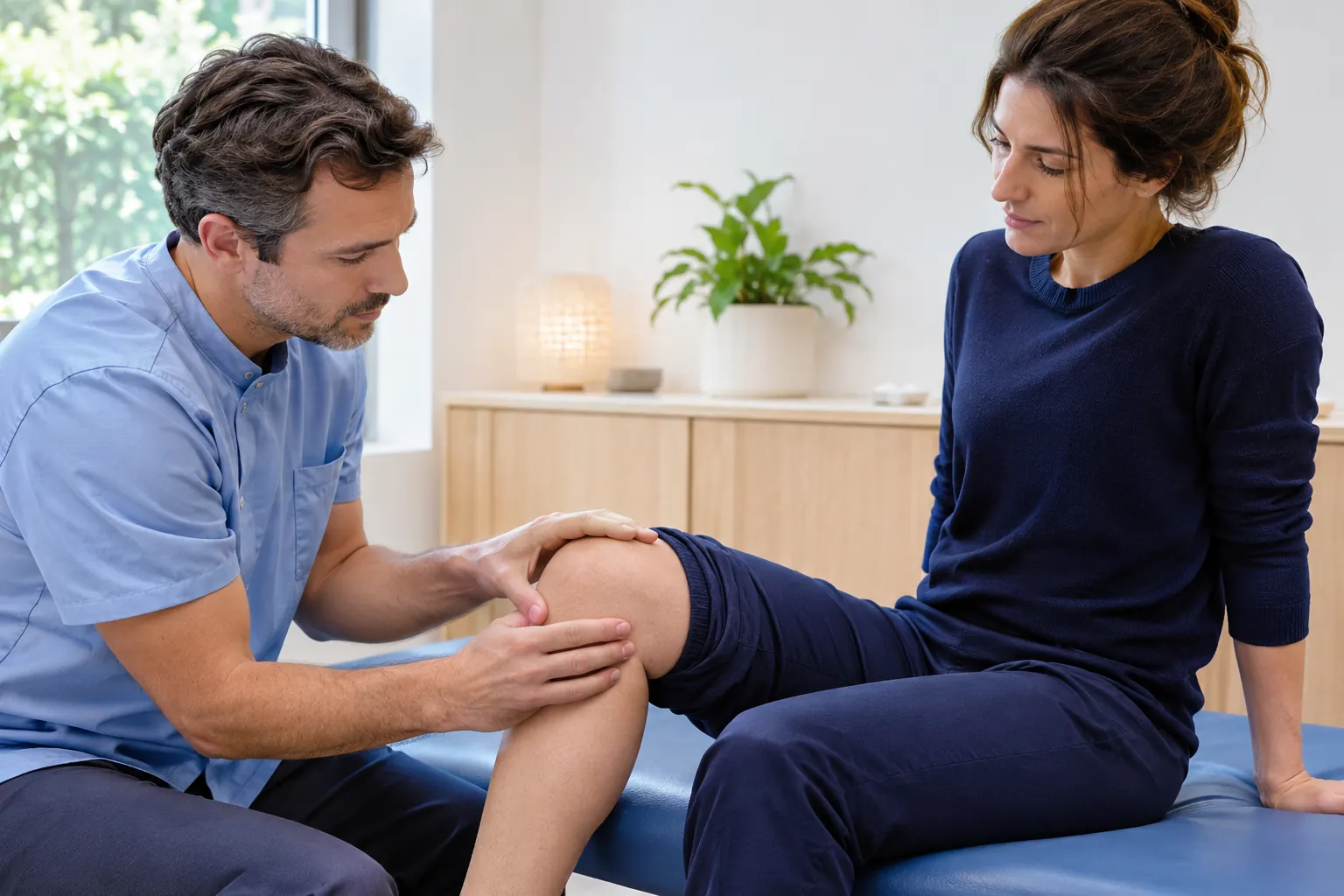
The examination takes into account trauma, swelling, blockage and support capacity. A warm and swollen knee with fever requires rapid medical advice. Complete blockage or loss of function after injury must be evaluated before a re-exercise or care seeking to force bending.
Scientific data and recommendations
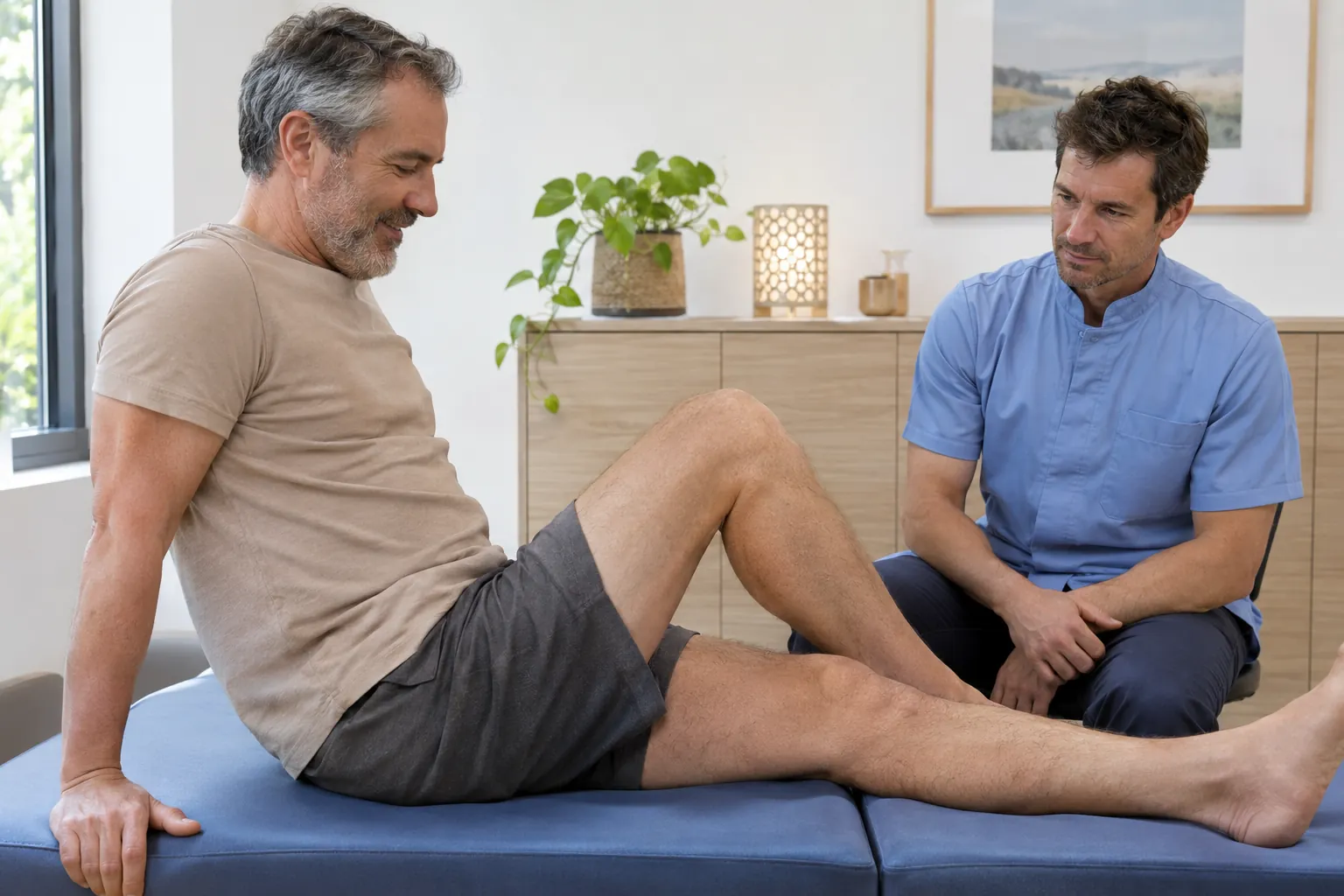
When diagnosis is osteoarthritis, NICE NG226 recommends appropriate activity and reinforcement. Possible manual therapy adds to exercise; it does not constitute sufficiently substantiated isolated treatment. A young athlete's pain or trauma requires a different reasoning.
What the results do not support
The relief obtained by contact, position or mobilization does not identify the responsible structure and does not measure the repair of a meniscus. Interventions should be judged on the function and duration of their effects, taking into account the usual fluctuations in symptoms.
Functional monitoring and coordination of care
Assembling a walk, sitting, walking or resuming a leisure provides concrete landmarks. It is useful to distinguish volume, intensity and recovery during recovery. A new instability, repeated effusion or progressive aggravation calls for reconsidering the diagnosis and program.
Scope of this file
- Population and situation
- Knee pain: stairs, walking and bending. The results must be interpreted for this specific situation.
- Choice of care
- When diagnosis is osteoarthritis, NICE NG226 recommends appropriate activity and reinforcement.
- Security priority
- Red and warm knee with fever, complete blockage, rapid swelling after trauma or impossibility of support: consult quickly.
Different compartments and functions
The knee combines the femoro-tibial and femoro-patellar joints, with menisques, ligaments and muscle control that contribute to different functions. An anterior pain in stairs is not equivalent to a knee that inflates after twisting. The mechanical symptoms reported should be specified: noise or apprehension does not have the same meaning as blocking that actually prevents extension.
Distinguish a condition from an imaging result
Degenerative anomalies visible on an image are not enough to attribute any pain to a structure. Decisions are based on the clinical picture and impact. For osteoarthritis, recommendations for activity and exercise should not be replaced by repeated passive care. An improvement after a manual gesture does not demonstrate meniscal repositioning or ligament repair; studies should measure relevant function and follow-up.
Bibliography and original documents
Editorial and documentary review: November 5, 2026. The references describe their scope; they are not valid for all osteopathic practices.