These benchmarks are general. They complete an exchange with the professionals who follow you and do not replace a diagnosis or an individualized program.
Benchmark 01
Why work his strength?
The force allows to rise, carry, climb stairs and practice chosen activities. Strengthening is therefore not reserved for the gym or for the search for muscle volume. It can make certain tasks less demanding and complete walking or other endurance activities. His interest is also measured in everyday life.
Choose a personal goal: to carry the races more easily, to resume an activity or to maintain autonomy. A concrete objective helps maintain practice when motivation varies. The general recommendations offer regular muscle work, but they do not determine the load and program for each individual.
Benchmark 02
Start with a readable session
Some families of gestures can organize a session: lift, push, pull, move a load and stabilize the body. Not all must be worked immediately. For a beginner, it is better to understand a small number of movements than to multiply workshops. A competent professional can help choose an accessible version and check the installation.
Provide a stable surface and sufficient space. If you use a tape, check its condition and the strength of its anchor; a wrongly chosen door handle can yield. Start with a resistance that leaves the movement controlled. Accessories are not essential for each lens: a stable chair or wall also allow variations.
Bench 03
Choosing a suitable difficulty
A series should ask for an effort without forcing you to speed up, block your breathing or lose control to finish. It is not necessary to go to exhaustion every time. Stop the series when the quality of the gesture deteriorates or pain appears. The number of repetitions can be adapted to the level, movement and target.
A feeling of muscle work is not identical to severe joint pain. If you do not know how to interpret a sensation or if you have a recent illness, injury or operation, ask for advice before pushing the effort. A video cannot determine the appropriate resistance to your personal situation.
Benchmark 04
Progress without modifying the entire program
When a variant becomes easy and remains well tolerated, change only one element: some additional repetitions, a little more resistance or a slightly different amplitude. This method facilitates observation of the reaction. There is no percentage of weekly progression that is suitable for all people and exercises.
Keep a simple track: chosen exercise, load or variant and general printing. This monitoring is used to identify progress and avoid inadvertent increases in all constraints. It must not become a permanent competition. In a busy week, a shorter session may be preferable to complete abandonment or excessive catch-up.
Bench 05
Leave a place for recovery
An unusual session may be followed by sternness. They are not a necessary condition for progress and do not prove that the program was well-measured. Before asking for the same area, consider fatigue and recovery. You can keep a pleasant light activity without trying to reproduce the previous session.
Sleep, regular meals and the organization of the week contribute to the continuity of training. A powder or accessory does not compensate for an untenable rhythm. If you also increase running, moving or physical work, consider the overall load rather than the single strength training session.
Bench 06
Adapt to life stages
The reinforcement can be adapted to very different profiles. With age, support and a stable sitting or standing version can sometimes start. After pregnancy, surgery or injury, certain criteria for recovery must be checked. The ability of the moment and specific instructions are more useful than comparison with an old level.
General demonstrations give ideas, not a prescription. If your goal concerns pain, unusual weakness or complex sports recovery, an individualized program may be required. Accompaniment aims to make movement understandable and progressive, without pretending that a single technique protects against all injuries.
A first step
Discover without maximum load
Example of organization to adapt to your situation, without performance objective.
- Clear space and choose stable support.
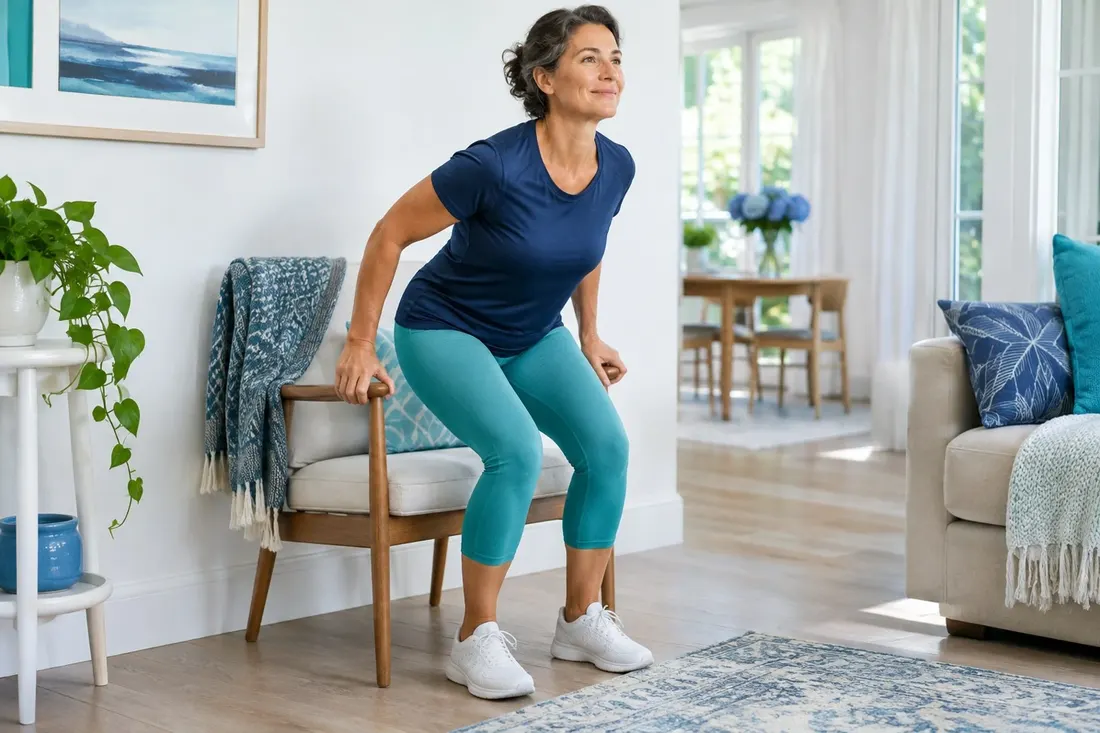
- Try some sitting-standing passages of a suitable chair if the movement is comfortable.
- Make some light thrusts against a wall, without pain or apnea.
- Keep the margin and note the variant chosen for the next time.

Traps to avoid
- Test a maximum load alone when restarting.
- Use sternness as a mandatory measure of progress.
- Increase simultaneously load, volume and frequency.
When can I ask for an opinion?
Chest pain, malaise, unusual shortness of breath or sudden weakness: stop and ask for appropriate help. Persistent severe pain, swelling or loss of function after the session requires evaluation.
Your questions
Should we go to the hall?
No. The location and material depend on the objectives and possibilities; several movements can be adapted to the home.
Do I have to feel any pain?
No. They may occur after unusual pressure, but are not necessary to progress.
Is reinforcement a substitute for walking?
These activities require different capacities and can complement each other. The program also depends on your constraints and your health.
The documentary selection
See, read, deepen
Illustrated directory of movements, to be adapted to your situation.
www.mangerbouger.frGuide / resource · EnglishStrength and flexibility — NHSPresentation of the various physical qualities and possibilities of practice.
www.nhs.ukVideo/Demonstration · EnglishReinforcement videos — NHSGeneral sessions in English; choose a suitable difficulty.
www.nhs.ukRecommendation · EnglishPhysical activity: WHO benchmarksInternational public health recommendations, distinct from an individual programme.
www.who.int