These benchmarks are general. They complete an exchange with the professionals who follow you and do not replace a diagnosis or an individualized program.
Benchmark 01
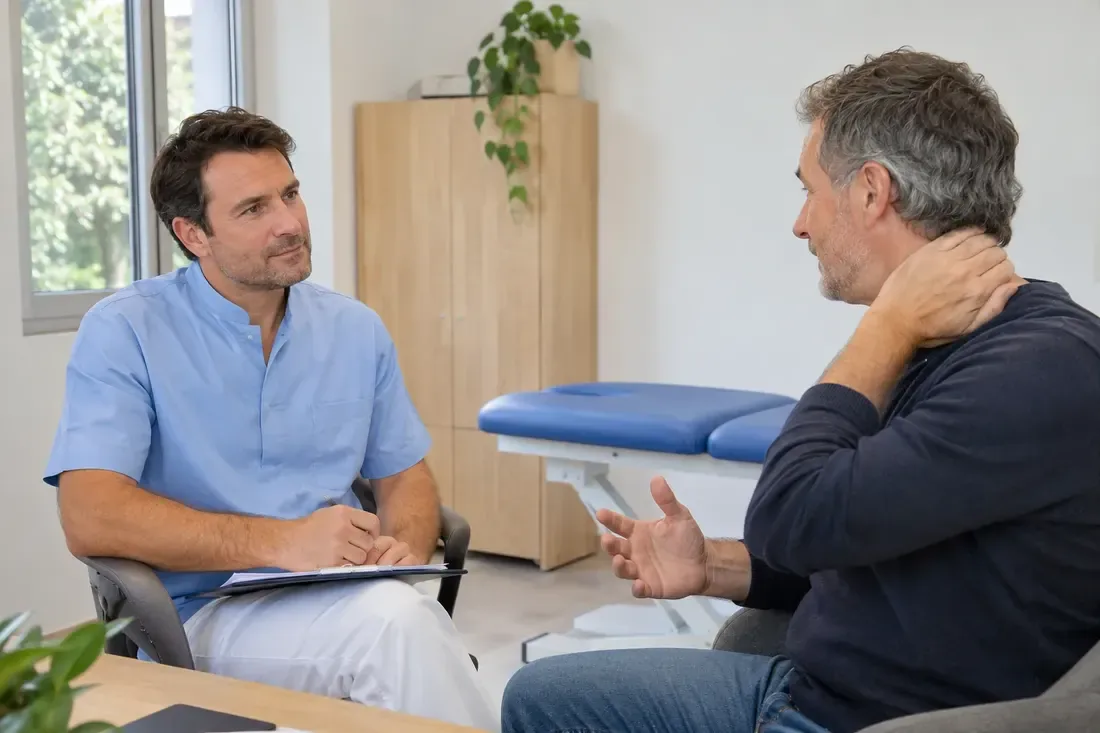
Understanding pain without concluding too quickly
The back and neck combine joints, discs, ligaments, muscles and nerves. Pain alone does not make it possible to designate a structure precisely. It can evolve with load, rest, stress or new activity. This does not mean that she is imaginary; it explains why the same person can feel differently at times.
Avoid summarising your situation to a displaced vertebra or unaligned pelvis. These images can give a lasting impression of fragility. If an examination or imaging has been performed, ask what the results actually change for your activities. Intelligible information helps to choose a progression without constant monitoring.
Benchmark 02
Adapt days rather than stop everything
When an inconvenience arises, identify the tasks that are still possible and those that require temporary accommodation. A shorter walk, a journey interrupted by a stop or a household divided in several moments can be options. The aim is not to act as if nothing happened, but to maintain a level of activity compatible with the situation.
Long periods of restlessness are generally of little use in common back pain. However, a short comfortable rest position can be part of the day. Then alternate with simple, tolerated gestures. It is not necessary to force yourself to perform all its usual activities from the first hours, nor to wait for a perfect absence of discomfort for each movement.
Bench 03
Taking a gesture that is avoided
Choose a concrete gesture, such as getting up from a chair or picking up a light object. Simplify it by using a support, a more accessible height or a reduced amplitude. Try slowly and observe your reaction during activity and then after. You are looking for a masterful experience, not a demonstration of courage or maximum test.
When this version is well tolerated, change only one element: a little more amplitude, a slightly longer task or less support. If symptoms increase lastingly, return to a simpler version and ask for advice if necessary. The progression is not always linear; a less good day does not erase the acquired abilities.
Benchmark 04
Neck, screen and daily life
For the neck, the comfort of reading and the possibility of changing positions often count more than a rigid posture. Place frequently used objects within range and enlarge the text if you continuously move the head. After a prolonged task, a few steps or a change in activity can be easier to integrate than a long exercise routine.
During a trip, make sure you can turn your head sufficiently to drive safely. If this is not possible, adjust the displacement. To sleep, prefer a comfortable installation rather than a pillow presented as universal. A change of material is not always necessary; avoid chaining several purchases on the promise of anatomical correction alone.
Bench 05
Choosing and changing exercises
Walking, gentle movements and progressive reinforcement can have their place according to the clinical picture. No exercise is required for all backs. If a routine found online worries you or causes symptoms, ask for a variant. After an operation, fracture or known pathology, the instructions of the healthcare team take precedence over general proposals.
A very simple notebook can help: done activity, approximate duration and impact on a useful gesture. There's no need to note every sensation. The development of abilities is assessed mainly: walking, working, wearing or sleeping. Manual processing, when discussed, should not replace a strategy that allows you to regain autonomy.
Bench 06
Know when to change strategy
Ask for advice if the pain persists, worsens, repeats in a worrying way or severely limits your activities. A reassessment is used to test the hypothesis, associated factors and management options. It does not automatically mean that exams must be multiplied. Their interest depends on the symptoms and what they might change.
The advice offered concerns non-emergency situations and does not allow recognition of all the causes of pain. A pain with fever, serious trauma, a lack of strength or a recent change in urinary function is not treated as a simple stiffness. In these situations, medical guidance takes precedence over exercises.
A first step
A functional starting point
Example of organization to adapt to your situation, without performance objective.
- Choose a short activity already tolerated, such as walking in housing.
- Identify a gesture to be simplified with a more accessible support or height.
- Do some comfortable tests without unusual load.
- Observe the reaction and schedule a reasonable next test rather than a maximum test.
Traps to avoid
- Stay in bed for several days for fear of moving.
- Force a movement that produces radiation or severe pain.
- Look to crack his neck to check that he's back in place.
When can I ask for an opinion?
A recent loss of urinary or fecal control, insensitivity of the perineum, significant or progressive weakness, chest pain or serious trauma requires an urgent assessment: 15 or 112 depending on the situation. Fever, malaise or rapid aggravation also require quick notice.
Your questions
Do you need an X-ray to know what to do?
Not systematically. Clinical examination and evolution guide the decision; imaging is useful when it can change management.
May I lean?
Movement is not prohibited in principle. It is reintroduced according to the situation and tolerance, after notice if there is a particular injury or pathology.
Does a crack mean a correction?
No. A joint noise does not prove that a joint was displaced or that the result will be better.
The documentary selection
See, read, deepen
Presentation of the application and its back video exercises.
www.ameli.frVideo/Demonstration · EnglishBack pain and video — NHSClinical information and movement demonstration; consult safety criteria.
www.nhs.ukGuide / resource · EnglishRachis programme — AAOSFigured exercises to select according to your situation, especially after injury.
www.orthoinfo.orgRecommendation · EnglishLower back pain and sciatalgia — NICEReference for professionals on assessment and care.
www.nice.org.ukGuide / resource · EnglishNeck pain — NHSMarks for cervical symptoms and orientation.
www.nhs.uk