These benchmarks are general. They complete an exchange with the professionals who follow you and do not replace a diagnosis or an individualized program.
Benchmark 01
Flexibility and mobility: two similar ideas
Flexibility commonly refers to the possibility of elongating certain fabrics or reaching a position. Mobility is also concerned with the ability to control movement and use it in an activity. Touching your feet is therefore not a summary of the health of your back. A significant amplitude can be useful for a particular sport without being necessary in everyday life.
Start with a concrete function: turn your head to look behind you, raise your arms or fall down more comfortably. This intention allows you to select relevant movements. A program can combine slow movements, muscle work and general activity; accumulating stretching from all regions is not indispensable.
Benchmark 02
Choose between motion and hold
To explore an amplitude, you can make a slow movement, return quietly and start over again. For sustained stretching, install a gentle feeling of tension without holding your breath. Both formats exist; the best choice depends on purpose, tolerance and context. There is no reason to suddenly overcome resistance or pain.
Avoid bumps to quickly gain a few centimetres. Take some support if it reassures you and leave a margin before the end of amplitude. If a position causes joint pinch, burn, irradiation or tingling, exit. These sensations should not be interpreted as evidence that stretching works better.
Bench 03
Set up a small appointment with the movement
A short session can be more lasting than an ambitious programme rarely carried out. Choose an easily available moment and prepare a clear space. Start with some ordinary movements, like walking in the room and gently moving the arms. The idea is to get in touch with its sensations rather than immediately test its maximum amplitude.
Then select two or three adapted movements and keep the possibility to simplify them. A stable chair or wall can be used as support. Finish by checking if a familiar gesture looks as comfortable as before. This functional control is more useful than systematically measuring a distance or comparing your flexibility with that of a video.
Benchmark 04
Before and after sport
Before an activity, gradually prepare the gestures and intensity you will use. For a quick walk, it can simply start with a slower walk. For a technical activity, heating requires a suitable preparation. An isolated stretch does not replace this progression and does not provide injury prevention alone.
After the sport, you can prefer to walk quietly, relax or make gentle movements if they are pleasant. Stretching is not an obligation to make the session "complete". They do not guarantee the absence of curvature. If you are very tired, avoid taking advantage of the relaxation to push much further than usual.
Bench 05
Hardness, pain and hypermobility
A feeling of stiffness does not always mean that a muscle is too short. It may vary with immobility, sleep, unusual load or pain. So stretching is not automatically the answer to any discomfort. If an area becomes more and more sensitive despite the exercises, it is better to review the choice and dosage rather than insist.
Conversely, when a joint is already very mobile, looking for more amplitude is not necessarily useful. Control and strength in a comfortable area can become priority. After an injury, an operation or in the presence of a particular disease, the limits of movement must be specified with the professional following the situation.
Bench 06
Read a demonstration with a critical look
A video lets you see a rhythm and a position, but can't examine your mobility. First watch the exercise without doing it and check who it is addressed to. Look for an accessible variant, the presence of supports and stop instructions. A spectacular achievement or a high amplitude is not a criterion of pedagogical quality.
The resources proposed here show general possibilities. Their interest is to facilitate the learning of movement, not to promise the correction of a misalignment. Choose a practice that you can easily repeat. If you need exercises for an identified pain, a custom selection is preferable to the assembly of several routines found online.
A first step
A gentle exploration, if you are healthy
Example of organization to adapt to your situation, without performance objective.
- Walk quietly for a few moments in an open space.
- Sitting or standing with support, gently rotate the head in a small comfortable amplitude.
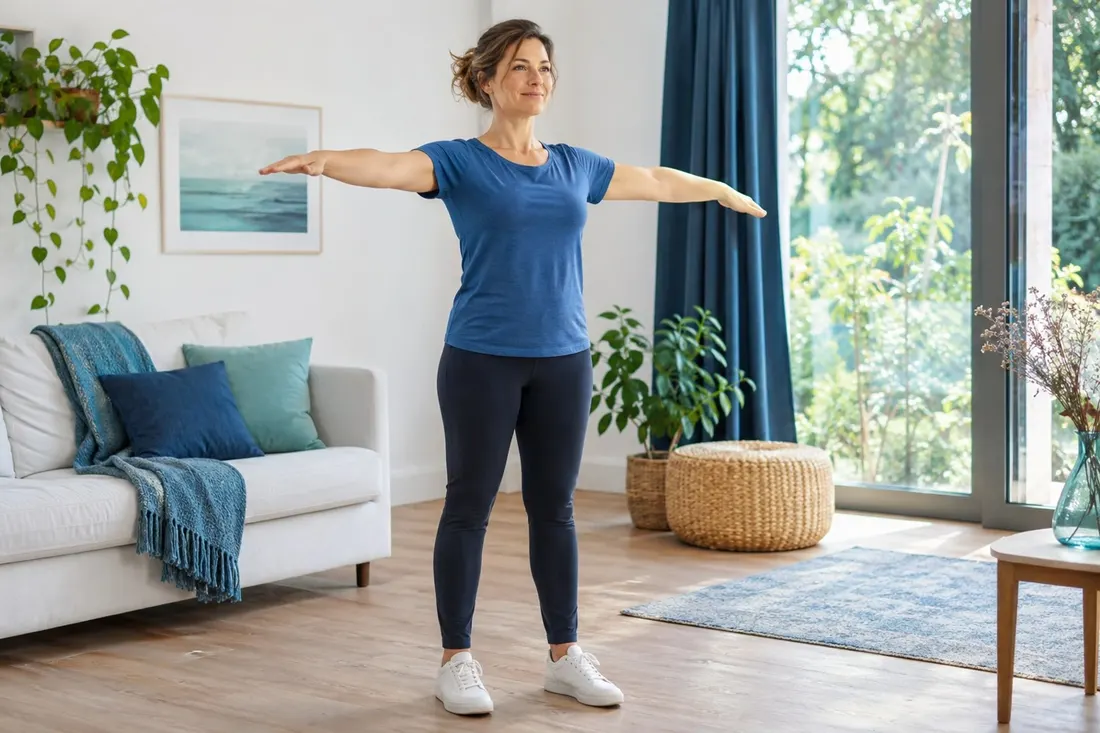
- Make a few shoulder movements and raise arms only up to an easy height.
- Finish with a few steps and keep only pleasant movements.

Traps to avoid
- Spend more or hold your breath to go further.
- Seek to reproduce the flexibility of another person.
- Extend a general routine to a recent injury without adaptation.
When can I ask for an opinion?
Stop a movement that triggers severe pain, irradiation, dizziness or neurological sensation. Significant new limitation, trauma or persistent symptoms warrant appropriate advice.
Your questions
Should we stretch every day?
There is no universal frequency. Regular and comfortable practice can be chosen according to your needs, without daily obligation.
Is tension during stretching normal?
A gentle sensation may occur. Vibrant pain, pinching or tingling are not sought.
Should we be flexible to start the sport?
No. Many activities begin with an ordinary amplitude and a suitable progression.
The documentary selection
See, read, deepen
Illustrated demonstrations to choose according to your abilities, without forcing.
www.mangerbouger.frGuide / resource · EnglishSoft mobility — NHSGeneral demonstrations to explore different possibilities of movement.
www.nhs.ukVideo/Demonstration · EnglishVideos Strength and Flex — NHSSee movements and their variants; general exercises in English.
www.nhs.ukGuide / resource · EnglishSitting movements — NHSAlternatives with chair to start in a stable environment.
www.nhs.uk