These benchmarks are general. They complete an exchange with the professionals who follow you and do not replace a diagnosis or an individualized program.
Benchmark 01
Make room for movement on an ordinary day
For children and adolescents, the public health objective is an average of at least one hour of moderate to sustained activity per day over the week. This time can bring together several moments: walk to school, play outside, run at recreation or participate in training. It is not necessarily an extra hour of organized sport.
If your child is not moving at this time, start from an activity that he or she likes and makes accessible. A accompanied walk or regular play after school can be a first choice. Gradually increase and avoid turning each activity into a performance measure.
Benchmark 02
Variant rather than bet everything on a single drive
Running, climbing, dancing, jumping, pedaling or playing a ball game require different skills. The variety helps to keep pleasure and discover what the child loves. Activities that cause muscles and bones to work find their place several days a week, depending on age and abilities.
During a recovery after a less active period, an intensive internship or several close competitions may represent a significant change. Discuss the rhythm with the coach and keep a place for recovery. Repeated pain is not a necessary passage to progress.
Bench 03
A workspace that adapts to the child
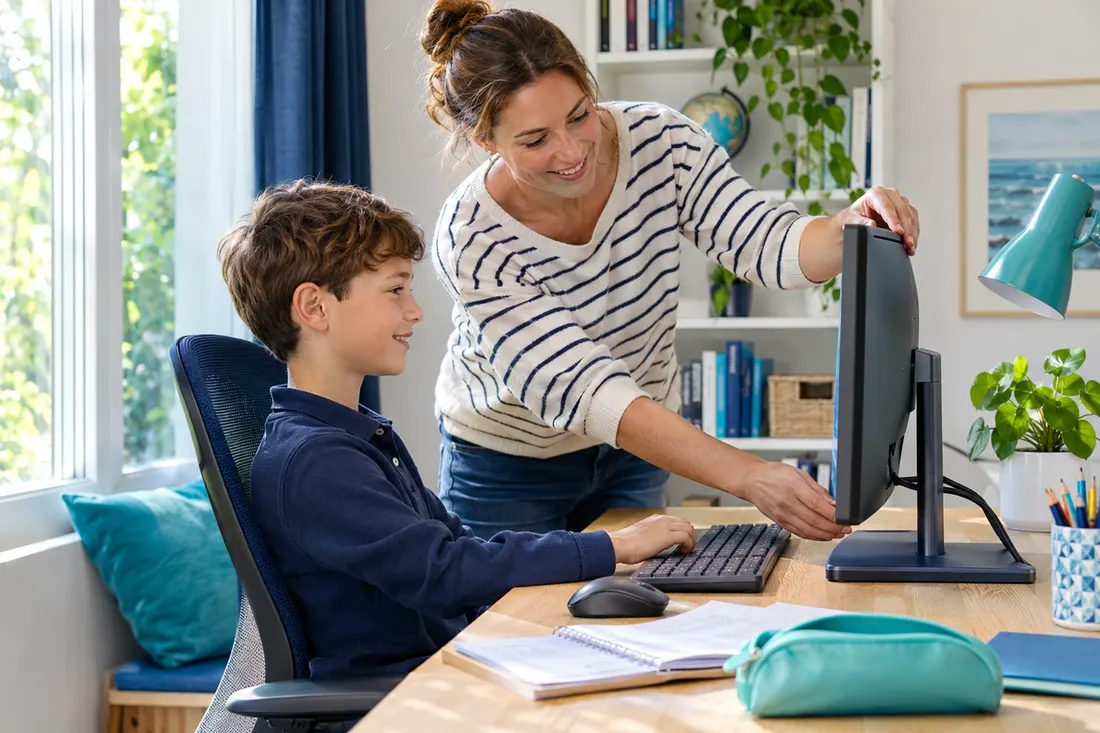
Install notebooks and easy-to-reach material. Look for a seat for comfortable supports and a readable screen without getting too close. The installation is re-evaluated when the child grows up or changes equipment. Simple support can sometimes improve comfort without buying specialized furniture.
The starting position does not have to become a frozen position. Between two exercises, the child can get up, look away or change support. Ask him what becomes uncomfortable rather than continually correct it. If the job remains difficult despite simple adjustments, also look for a possible vision problem or other difficulty with the professionals concerned.

Benchmark 04
Build a family agreement on screens
A useful agreement describes the moments that one wants to preserve: meals, homework, outside activity, exchanges and bedtime. It also specifies where devices are stored and how notifications are managed. Involve the child in choices and adapt the rules to his/her age, usage and family organization.
Adults are part of the plan. You can start with a common rule that is easy to hold, and then take stock a week later. The challenge is to preserve important activities and accompanied use; a minute counter alone does not describe the quality of all uses.
Bench 05
Listening to pain without explaining it too quickly
A back or neck complaint should be specified: when does it appear, what activities have been affected, since when and with what evolution? Also note if the child wakes up, avoids a gesture or box. Pain should not be automatically attributed to the bookcase, growth or posture observed in a photo.
After trauma, difficult recovery or persistent pain, ask for an assessment. The doctor looks for possible causes and determines the appropriate activities. The aim is to maintain a comfortable participation, without imposing any systematic prolonged cessation or continuation of sport despite worrying symptoms.
A first step
A family deal for this week
Example of organization to adapt to your situation, without performance objective.
- Choose together a moment of appreciated and realistic movement.
- Check the comfort of the homework area with the child installed.
- Decide on a moment without a device that also concerns adults.
- Take a short look at the weekend: pleasure, fatigue, comfort and difficulties encountered.
Traps to avoid
- Present an imperfect posture as a certain deformation of the column.
- Make pain a proof of effort or sports motivation.
- Changing all family rhythms at the same time with hard-to-reach goals.
When can I ask for an opinion?
Pain that wakes up regularly, fever, lameness, refusal to support, weakness or pain that worsens after trauma require medical advice. A sudden inability to walk or a new neurological symptom warrants an urgent assessment.
Your questions
Should the activity be done in a single session?
No. Games and trips can add up during the day; the recommendations cover the whole week.
Should we keep reminding my child to stand straight?
It is better to look for a comfortable installation and allow for change of position. Persistent pain requires an assessment rather than ongoing monitoring of posture.
How to start if my teenager doesn't like sports?
Explore your preferences: walk with a friend, dance, bike or group activity. Choice and pleasure facilitate a long-lasting habit.
The documentary selection
See, read, deepen
Benchmarks by age, including children and adolescents.
www.who.intRecommendation · EnglishNHS — Activity of children and adolescentsActivity references and ideas for various practices.
www.nhs.ukRecommendation · EnglishWHO — Physical activity and sedentarityInternational recommendations by population.
www.who.intGuide / resource · EnglishPAA — Building a Family Plan for the MediaTool to define together uses and protected moments.
www.healthychildren.orgGuide / resource · EnglishAAOS — Back pain in childrenUnderstand the reasons for medical assessment.
www.orthoinfo.orgRecommendation · EnglishRoyal Childrens Hospital — Children who areClinical reference on lameness and warning signs.
www.rch.org.au