These benchmarks are general. They complete an exchange with the professionals who follow you and do not replace a diagnosis or an individualized program.
Benchmark 01
Choose an activity compatible with your situation
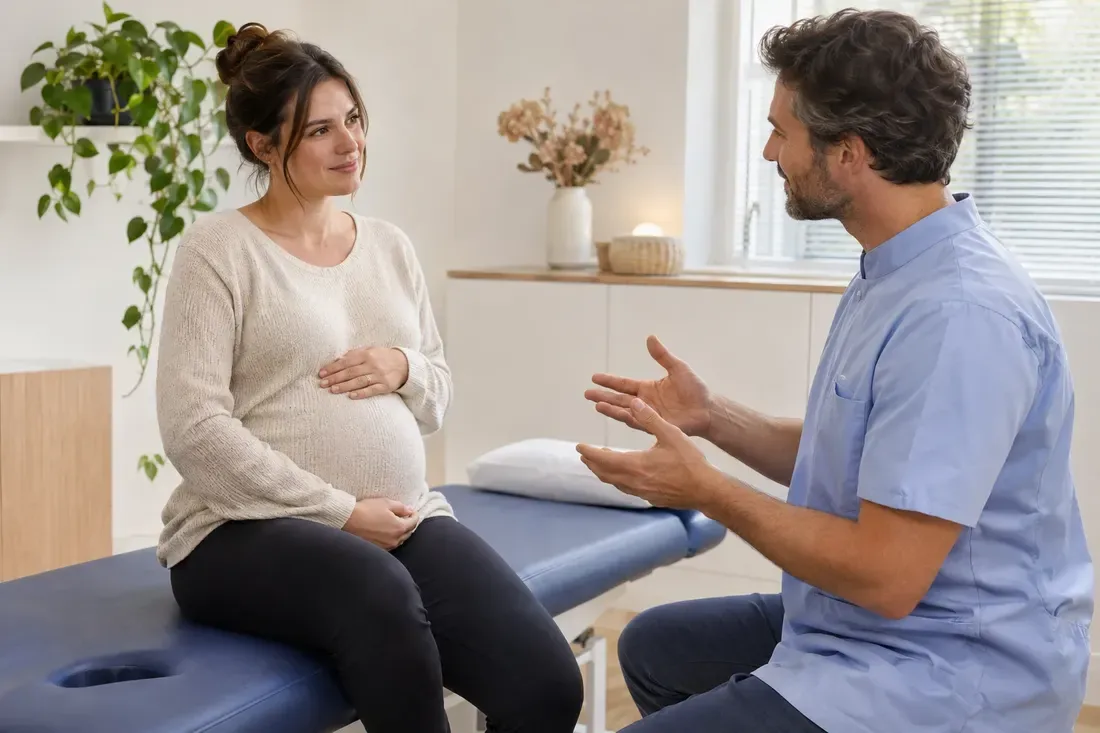
Your starting point counts: usual practice, term, fatigue, history and possible complications. Talk to the midwife or doctor following pregnancy about your activities. An already active person and a starting person do not need the same program.
For pregnancy without contraindications, the recommendations suggest a moderate activity of about 150 minutes per week. They can be divided into small sequences. If this objective seems remote, a short and regular walk is a possible starting point. Activity varies from week to week.
Benchmark 02
Recognize an effort that remains comfortable
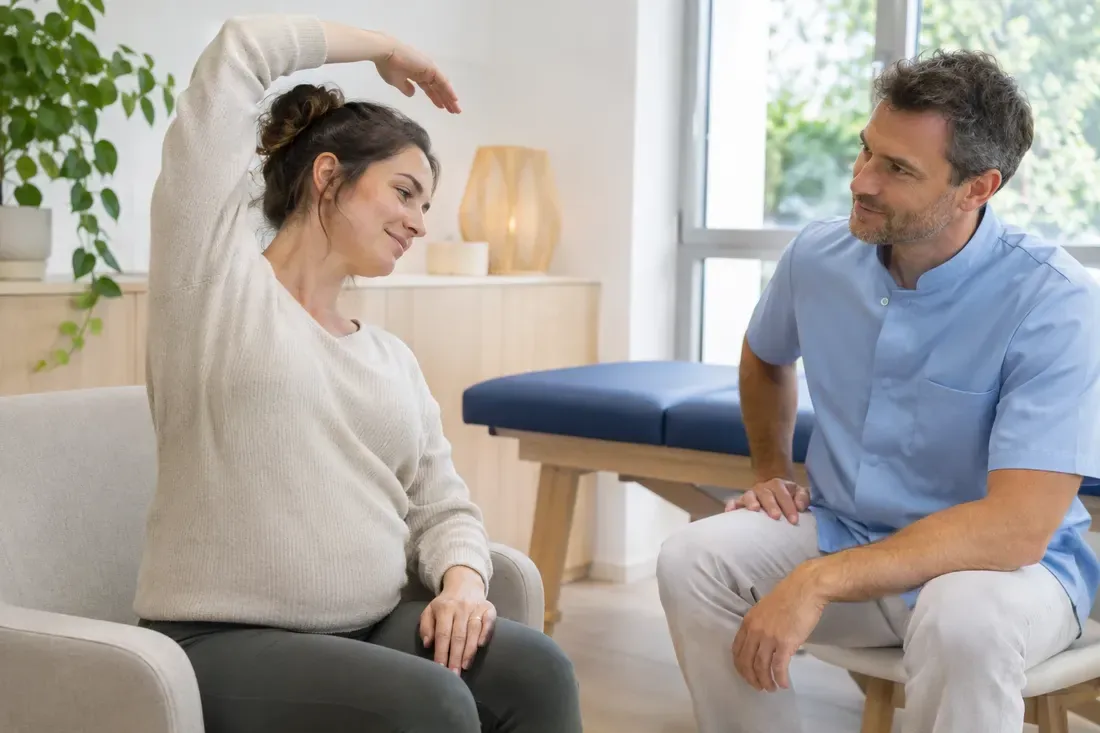
At moderate intensity, breathing accelerates while allowing to speak. Use this benchmark rather than a comparison with your previous performance. Walking, swimming or a suitable prenatal course may suit your preferences. Notify you of your pregnancy and report any discomfort.
Plan for water, suitable clothing and an environment that avoids overheating. Prolonged flat positions on the back may become poorly tolerated during pregnancy; change position and seek advice if they cause discomfort. Avoid situations with significant risk of fall or abdominal shock.
Bench 03
Adjusting gestures and organization
If an activity becomes uncomfortable, look for what can be split or simplified: walking time, standing time, travel, storage or carrying loads. Variate positions and provide for a rest option. A practical adaptation is often more useful than a perfect gesture search.
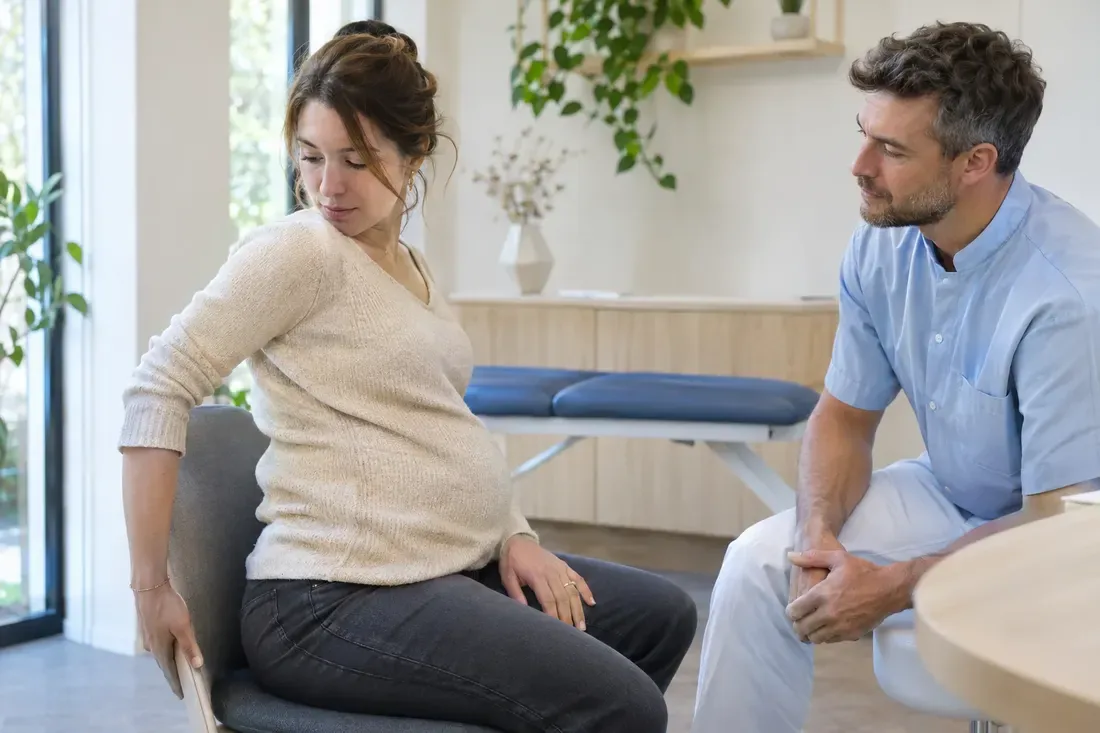
For pelvic pain or difficulty that limits walking, ask the follow-up team. Describe the movements involved and their evolution. Do not interpret pain as a displaced pelvis and do not try to test its limits yourself. Individualized assistance may include appropriate activities, support and care.
Benchmark 04
After birth: resume from the present state
Recovery depends in particular on childbirth, healing, sleep and possible complications. The first tests can be very simple: ordinary movements, short walking and gradual increase according to tolerance. A caesarean section or a medical problem requires specific instructions.
Make the point after activity and the next day: pain, unusual fatigue, scar discomfort, feeling heavy or leaks. These observations help adjust the load and prepare an exchange. A well-tolerated session does not mean that all activities are already adapted.
Bench 05
Back to impacts, racing or strength building
Resumption of more demanding efforts is discussed according to functional recovery. The timetables proposed by the institutions are not all identical and do not replace an individual evaluation. Recommence with a suitable constraint, then increase a parameter at the same time rather than duration, intensity and frequency together.
Pelvic symptoms, persistent pain or healing difficulties are to be reported. A professional can guide you to an appropriate work; this page does not prescribe a universal program of perineal contractions. Support for entourage, access to rest and realistic goals are part of the organization of recovery.
A first step
Preparing for your next activity
Example of organization to adapt to your situation, without performance objective.
- Choose a modest goal compatible with the instructions of your follow-up.
- Plan an easily interrupted trip or session, water and comfortable outfit.
- Observe your breathing, comfort and any new symptoms.
- Note your recovery to adjust the next session and discuss it if necessary.
Traps to avoid
- Start an intense new practice alone during pregnancy.
- Retake the race only because a theoretical date has passed.
- Continue an effort despite pelvic gravity, unusual pain or discomfort.
When can I ask for an opinion?
During pregnancy, stop exertion and contact the obstetric team in case of bleeding, loss of fluid, regular painful contractions, malaise, chest pain, unusual shortness of breath or pain and swelling of a calf. After birth, significant symptoms or rapid worsening also require medical assessment.
Your questions
Do I have to reach 150 minutes a week right away?
No. It is a progressive benchmark for an activity-compatible situation. Start at your level and adapt to follow-up and symptoms.
When will I be able to use it?
There is no valid date for all. Recovery, symptoms and the type of delivery guide an accompanied recovery.
Does a short walk count?
Yes. Splitting an activity can help make it compatible with your energy and organization, both during pregnancy and after birth.
The documentary selection
See, read, deepen
Francophone resources of the Centre hospitalier universitaire Vaudois.
www.chuv.chVideo/Demonstration · EnglishNHS — Move during pregnancyPractical tips and video of midwife on the official page.
www.nhs.ukGuide / resource · EnglishACOG — Exercise during pregnancyFrequently asked questions, precautions and signs of stopping effort.
www.acog.orgGuide / resource · EnglishACOG — Exercise after pregnancyBenchmarks for recovery taking into account recovery.
www.acog.orgGuide / resource · EnglishHSE — Recovery from zero to 12 weeksStaged progress proposed by the Irish Health Service.
www2.hse.ieRecommendation · EnglishGovernment of the United Kingdom — Pregnancy and post-birthOfficial references and infographics on physical activity.
www.gov.uk