These benchmarks are general. They complete an exchange with the professionals who follow you and do not replace a diagnosis or an individualized program.
Benchmark 01
Building an accessible habit
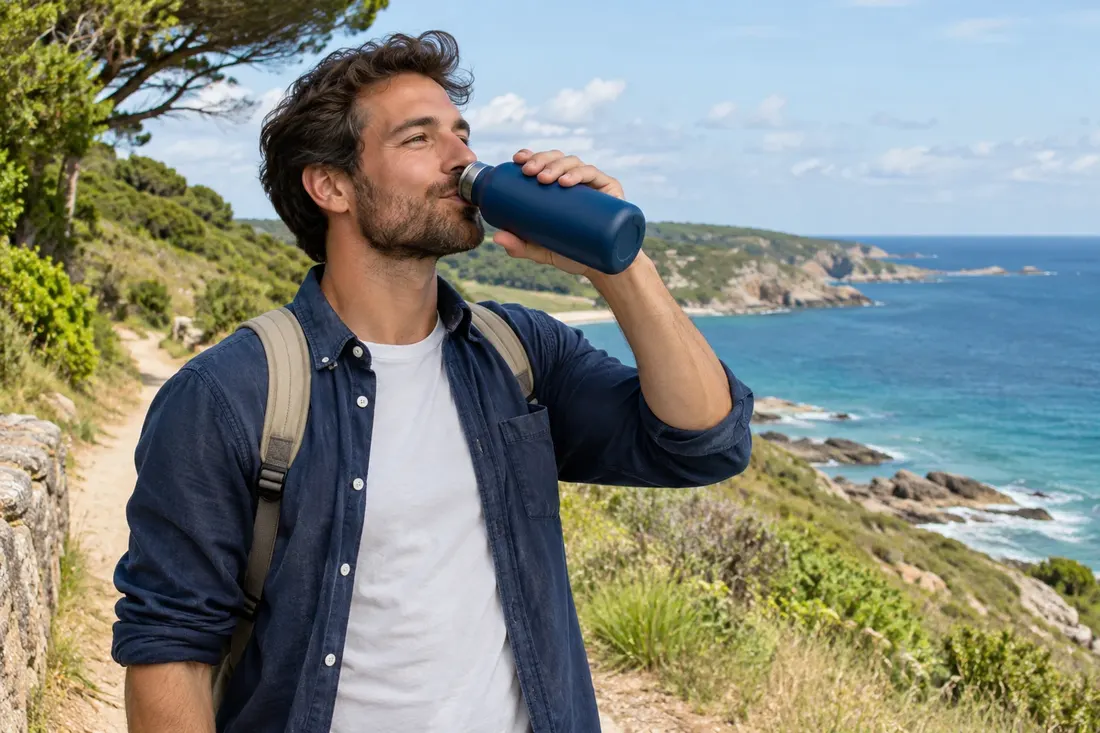
The most useful is not to find an identical volume for all, but to make the drink accessible. A drink at the meal, a gourd near the office, a break on arrival at home: these simple markers avoid waiting for the end of the day to drink. You can start with the habit that is most often missing in your organization.
Food also brings water. Climate, perspiration, duration of effort, pregnancy, breastfeeding and certain diseases are changing the situation. Population benchmarks are starting points; they are not individual requirements to be met at all costs.
Benchmark 02
Water, coffee, tea and sweet drinks
Water is a simple choice every day. If you enjoy tea or coffee, they contribute to liquid intakes; however, observe their effect on your sleep, your palpitations, if any, or a urinary emergency. A gradual reduction is sometimes easier to maintain than a sudden change. Energy drinks are not a solution to unexplained fatigue.
To reduce sweet drinks, start with a realistic replacement in your day. Flavored water at home can suit you. Juices do not always replace whole fruits. Alcohol is not a hydration strategy or recovery tool after sport.
Bench 03
In sport: preparing rather than compensating
Before an exit, think about its duration, heat, access to water and your experience. Bringing something to drink is easier than relying on an uncertain fountain. In hot weather, shortening the session, choosing a cooler schedule and slowing down may be more relevant than trying to maintain the planned program at any cost.
For ordinary leisure activities, water and regular meals are often enough. Long-term efforts, high heat or competitive practice require an individualized strategy. Do not apply a marathonian's protocols to a walk. Drinking excessive quantities can also be dangerous: you must not force yourself to absorb several litres quickly.
Benchmark 04
Read the signs with caution
A thirst, a dry mouth or darker urine may invite you to examine its intakes. The colour of the urine, however, is not a medical test: certain foods, vitamins or medicines modify it. Fatigue or headache may have many other causes than lack of water.
If you often have to urinate, if your thirst becomes unusual or if the symptoms persist despite appropriate habits, consult instead of simply increasing the quantities. Children, the elderly and dependents require special attention to access to drinks; this adult dossier is not a guide for infants.

Bench 05
Sickness, medicines and restrictions
Cardiac or renal failure may require specific instructions on liquids. Some treatments also alter water balance. Keep the indications of the healthcare team and ask how to adapt them during a heat wave or disease; do not change a diuretic treatment alone.
In case of severe diarrhoea or vomiting, replacing only water may be insufficient. The pharmacist or doctor may propose a suitable oral rehydration solution. Very salty or sweet improvised recipes, sodas and sports drinks are not interchangeable with these products.
Bench 06
Your mini check of the week
Not counting each sip, find two moments when you forget to drink and a time when the drink replaces a real need for rest or meal. Install a visible reminder, such as filling the gourd at the beginning of the day. After a few days, see if this marker is easy to hold before adding another one.
Regularity counts more than a follow-up performance. If the monitoring of quantities becomes anxious or invasive, return to simple markers and be accompanied. A habit of health must lighten daily life, not create a new permanent constraint.
A first step
An organization for tomorrow
Example of organization to adapt to your situation, without performance objective.
- Prepare a glass or gourd in your main place of activity.
- Provide access to water for a trip or exit.
- Follow any special medical instructions and adapt the activity in case of heat.

Traps to avoid
- Force to drink large quantities quickly.
- Treat any fatigue with energy drinks.
- Change water restriction or treatment alone.
When can I ask for an opinion?
Confusion, difficulty staying awake, major discomfort or difficulty breathing require urgent help: 15 or 112. Persistent dizziness, very little urine, vomiting preventing drinking or general deterioration require rapid advice.
Your questions
Do you need a graduated gourd?
It can serve as a reminder if you appreciate it, but it is not indispensable and does not determine your personal needs.
Is particular water needed?
The choice depends on your preferences, access and certain medical situations. No type of water replaces the management of a disease.
Do I need to drink more if I take fiber?
Adapted hydration accompanies dietary changes. If a restriction of liquids has been prescribed, ask how to reconcile these tips.
The documentary selection
See, read, deepen
Benchmarks to recognize signs and ask for appropriate help.
www.ameli.frGuide / resource · EnglishNHS — daily water and beveragesGeneral references, habits and situations where needs change.
www.nhs.ukGuide / resource · EnglishNHS — recognizing dehydrationSymptoms and situations requiring evaluation.
www.nhs.ukGuide / resource · EnglishNIDDK — Power, Liquids and TransitDigestive references and interest in individual adaptation.
www.niddk.nih.gov