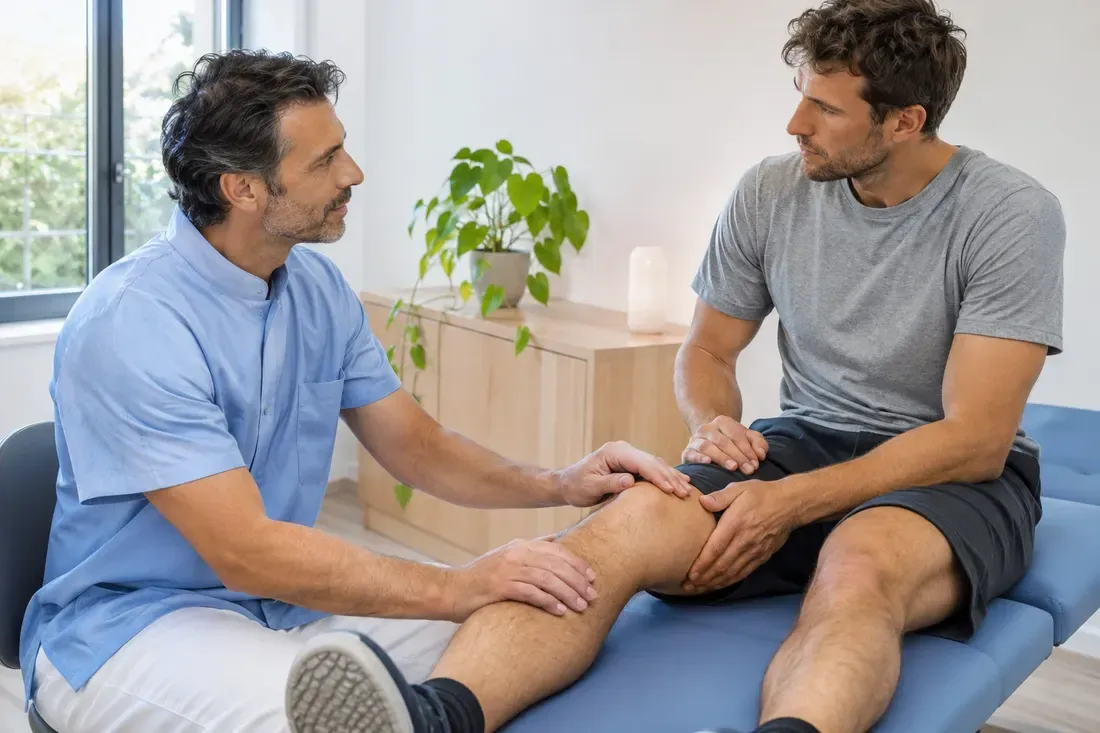

These benchmarks are general. They complete an exchange with the professionals who follow you and do not replace a diagnosis or an individualized program.
Benchmark 01
Select your starting point
A recovery begins with current capabilities, not those of several years ago. Think about what you're already doing in a week: walking, travelling, physical work and leisure. A period of inactivity, illness or a change in pace may alter tolerance. No delay should be caught in a single session.
Choose an activity that you enjoy and whose access is simple. Walking, pedaling or swimming can be options before running, or activities in their own right. A health goal does not necessarily require competition. If you have symptoms, a known disease or uncertainty about recovery, ask for appropriate advice.
Benchmark 02
Organize a realistic first week
Find really available slots and plan a fallback solution. A short session close to home can be more durable than a complicated move. Avoid filling immediately every free day. Recovery days are part of the organization, especially when the effort is new or more intense.
Prepare the outfit and a simple ride. Depending on the location, think about visibility, lighting, weather and the possibility of returning easily. You can start with a modest duration and finish with another margin. This sense of mastery often makes it easier to repeat more than a first session experienced as an event.
Bench 03
Start the race with an alternation
For a person who is not running yet, alternating walking and small racing sequences can make the effort more accessible. The initial objective is regularity and comfort, not speed. A guided beginner program, such as the NHS program, provides a possible structure. You can repeat a step if it remains demanding; the calendar is not an obligation.
The race level must keep a sense of control. If you have to finish each completely exhausted fraction, slow down or return to more walking. After injury or operation, a beginner's program does not constitute an authorization to take over: the criteria may be different and require an individualized decision.
Benchmark 04
Changing constraints
Duration, frequency, speed, terrain and surface contribute to the difficulty. If you increase several parameters at a time, it becomes difficult to understand a reaction. Choose a single evolution and keep the rest relatively stable. There is no universal numerical formula that guarantees the absence of injury.
Note your general impression, recovery and effect on the following day's activities. Unusual tiredness, disturbed sleep or recurrent pain may cause temporary reduction of the load. Also take into account the constraints outside sport: moving, long walks and physical work can add to apparently unchanged training.
Bench 05
Equipment and complementarity
Choose comfortable shoes, suitable for your activity and use. A particular model does not guarantee protection against pain. Avoid introducing new shoes, longer sessions and new surfaces at the same time. A purchase may meet a need, but does not replace a reasonable progression.
Reinforcement and control work can complement endurance according to the objectives. They must not turn a simple recovery into an unmanageable program. Also keep a place to enjoy: running with a loved one, choosing a pleasant ride or varying activities can support continuity. Comparison with online published performance is rarely a good starting point.
Bench 06
Distinguish adaptation and problem to be assessed
An unusual effort may leave muscle fatigue, but localized pain that goes back to each session deserves to be taken seriously. Reduce stress and observe evolution rather than multiply rapid tests. A lameness, swelling or loss of function is not only managed by a new stretch.
For a useful follow-up, define a specific question: how long is currently tolerated, what gesture triggers the discomfort, what time frame for recovery? These elements help the professional to propose an adaptation. The goal is a lasting recovery; ending a session despite worrying signals is not a criterion for success.
A first step
A discovery exit
Example of organization to adapt to your situation, without performance objective.
- Choose a short, known and easy to interrupt route.
- Start walking quietly and then increase lightly if everything goes well.
- For those who are ready to run, use a beginner program with a walk-run alternation rather than a speed target.
- Finish with a margin and schedule recovery time before the next unusual solicitation.
Traps to avoid
- Immediately resume its former training volume.
- Run with a lameness to finish the planned program.
- Present a progression rule as a guarantee against injury.
When can I ask for an opinion?
Stop in front of chest pain, malaise, palpitations with symptoms or abnormal shortness of breath. Ask for advice in case of persistent pain, swelling, inability to support or recovery after a major injury.
Your questions
Can I repeat a week of the program?
Yes. A calendar is a tool, not an exam; it can be adapted to your tolerance and organization.
Do I have to run to improve my health?
No. Walking and other activities can contribute to a more active life; choice depends on your tastes and abilities.
Can we go back with an old pain?
It depends on the picture and its evolution. Persistent or limiting pain deserves an appropriate assessment and strategy.
The documentary selection
See, read, deepen
Benchmarks to introduce more movement into everyday life.
www.mangerbouger.frGuide / resource · EnglishCouch to 5K — NHSProgressive walking-racing program with audio support in English.
www.nhs.ukGuide / resource · EnglishRace restart — Berkshire Healthcare NHSPhysiotherapy resource to understand a gradual recovery.
www.berkshirehealthcare.nhs.ukGuide / resource · EnglishStarting the race — Healthdirect AustraliaPractical advice for an Australian public health service.
www.healthdirect.gov.auGuide / resource · EnglishActivity and risk of injury — NHS informsBenchmarks for the preparation and adaptation of practice.
www.nhsinform.scot